


Lead sheets
The most basic way to represent a song is a leadsheet which shows the given melody and the chords above the staff, usually one or two chords per bar of music.
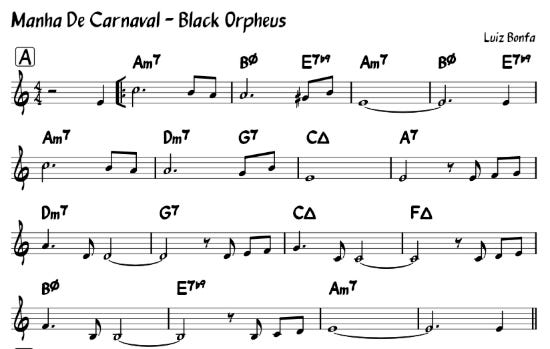
You find these lead sheets in jazz real books or fake books, or on websites like Musescore.
This is the barebones structure of the tune from which to develop some sort of an interpretation or arrangement.
A leadsheet is not what you perform or a transcription of a performance, but an architectural representation of the composition.
This is important: if you play the basic chords as given, that won’t be wrong, but it’s unlikely to result in an effective performance because of the need for ‘voice leading’.
We'll look at voice leading later on — for now, the point is that a lead sheet gives you the structure, not the finished performance.
A fully developed arrangement or transcription of a performance is an interpretation of this basic structure in a given key for a given instrument or ensemble type.
Chord charts
Another common basic representation of a tune is the chord chart.
You can find these on the iRealPro app.
This is what jazz musicians are often looking at on their iPads if they’re not familiar with the tune.
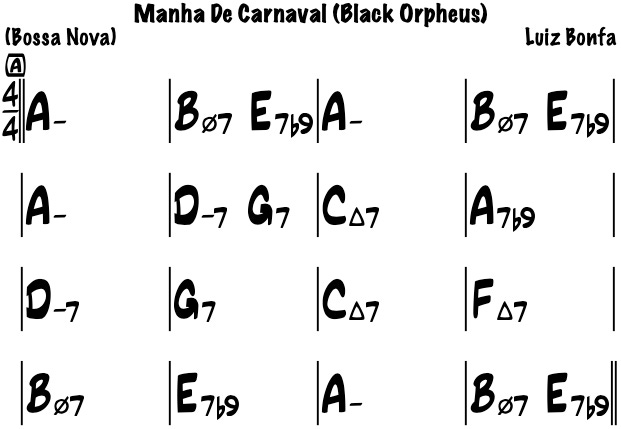
In order to learn how to interpret a chord chart to create an arrangement or a performance we need to understand how musicians understand the chord chart.
Musicians look at the chords in terms of their function or position in the scale.
To understand this we first need to look at the harmonised scale.
Harmonised C Major Scale
The harmonised scale is the chords that are built by stacking only the scale notes a third apart.
The C major scale:
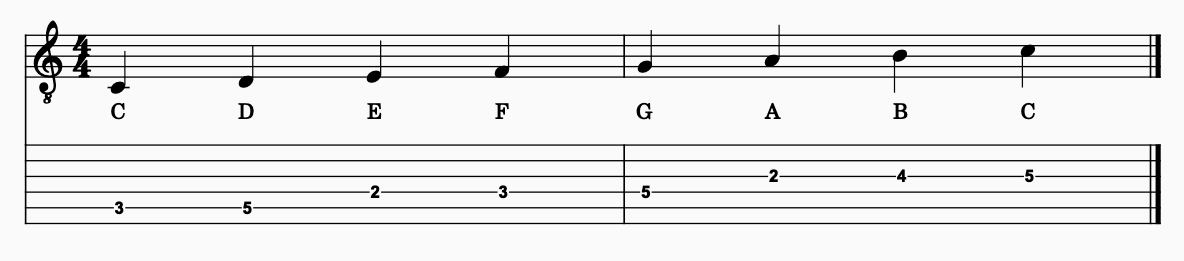
2. Harmonised C major scale (R-3-5-7)
The harmonised C major scale is the chords built by starting with the root note (R) on each scale degree, and then stacking notes a third apart (R - 3 - 5 - 7) as follows:
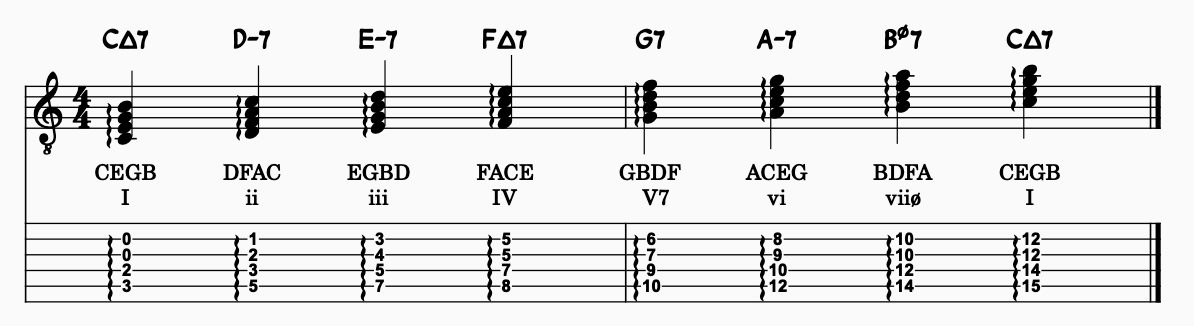
We only use notes that are inside of the scale, and the technical expression often used by jazz musicians is to say that these notes are ‘diatonic’ to the scale.
Each chord built in this way is assigned a Roman numeral which indicates the function of the chord in the scale.
So when jazz musicians look at a chord chart like the one above, they look at the chords in terms of these numerals.
You will notice that major chords—which includes major and dominant chords—are given a capitalized numeral, whereas minor chords are given a small numeral.
Dominant chords are indicated with a 7.
Also, half diminished—minor 7 flat 5 (-7b5)—chords are often indicated with the ø symbol.
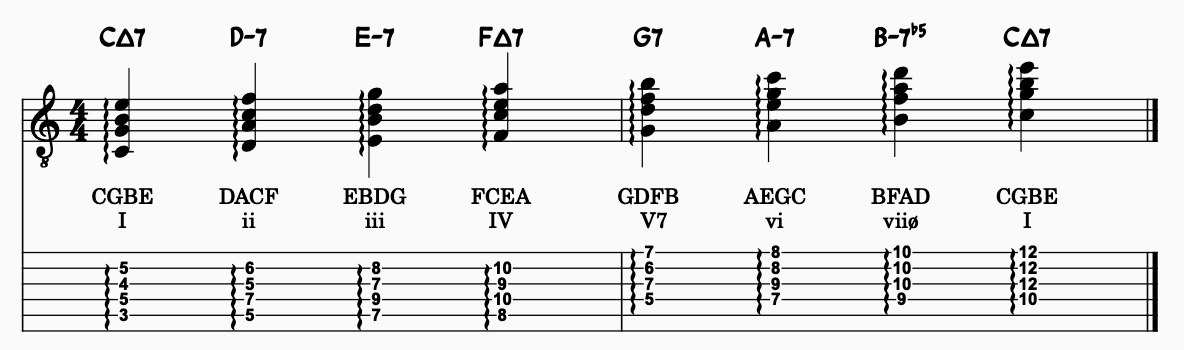
3. Drop two voicings (R-5-7-3)
As you might have noticed, the chord fingerings for chords created by simply stacking thirds are often impractical on the guitar, and also don’t necessarily sound the best.
So this scale is normally practiced using ‘drop two’ voicings, with the 3rd moved to the top of the chord, as follows:
4. Shell voicings (R-3-7)
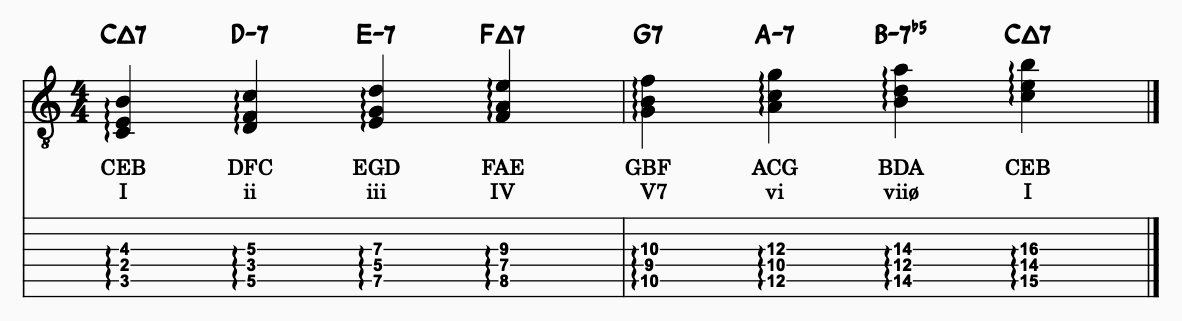
The voicings above are the most common fingerings of the basic 7th chords on the guitar.
However, playing the chords in this way, gripping all four tones, does not leave much room for extended ‘colour’ notes.
The essential tones are the root, the 3rd and the 7th, as these give you the chord and the chord quality (major, minor, dominant).
These give us ‘shell’ chords using just the essential tones:
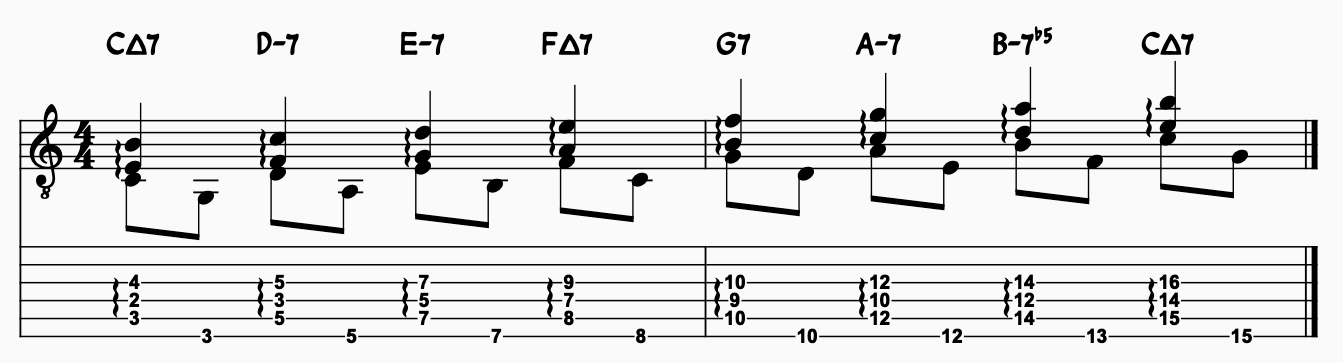
5. 5th in the bass (5-R-3-7)
Omitting the 5th entirely, or playing it in the bass (often instead of the root tone), is very common in jazz and bossa nova:
Final notes
The point here is not to ‘practice scales’ so much as to understand how chords are constructed and what functional harmony is.
Practicing the harmonised scale as given above, up and down the neck, will not sound particularly musical.
We need to devise special exercises to make it sound musical, which will be the subject of the next lesson.
Please leave questions and comments below!
This is great! So glad I found you on here! I’ve been playing guitar for a really long time, but just recently started taking proper lessons. I’ve been pretty overwhelmed with everything I don’t know, and these lessons of yours are so very well-written. This is going to help me a lot! Thank you for doing this!