


The Fundamental Cadence
We understand Western music (music which uses the diatonic scale) in terms of movement away from and back towards a tonal centre at any point in a piece of music.
If we play the C note together with the G note, the ear hears C as home. The G feels unresolved — it wants to move to the C.
Try it on the guitar: play the two notes together, then play just the C. You’ll hear the C as the settled, resting note.
This pull from G to C is the V–I relationship, and it’s the strongest sense of movement in Western music. The G is the V of C, and when it moves to C, we hear the music arrive.

This V-I relationship is the strongest cadence, tendency or movement in Western music
We can view a chord progression as movement away from the tonic ‘home’ and then return back to it
This tension and resolution gives Western music a sense of direction and forward movement
V7-I Cadence
As we saw in lesson #2, the V chord in a major key is a dominant V7 chord, which is the G7 in the C major scale:
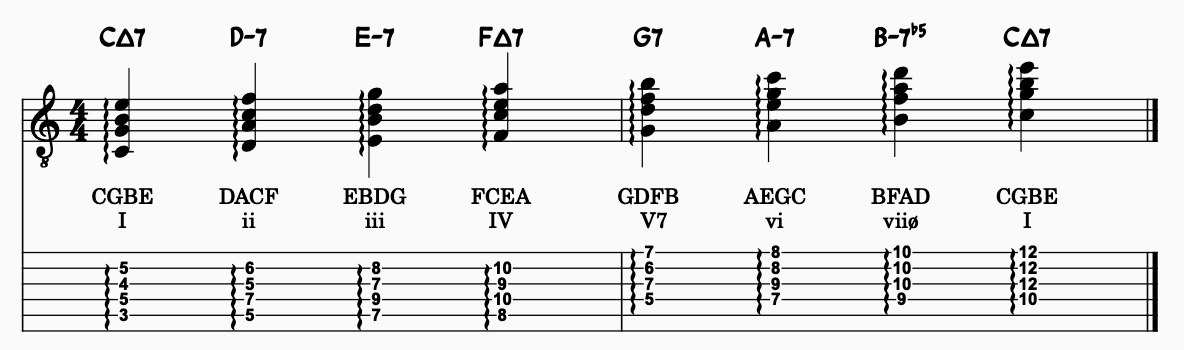
You will find that when you get to the G7, it will sound more natural or musical to return to C immediately after the G7:
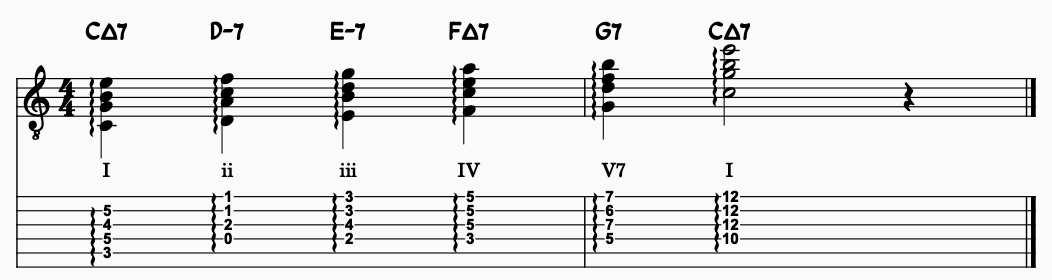
In some genres like tango or bossa nova, the V7-I cadence will be very common in the course of a tune
it will also be found at the final bars of a section as well as the end of the whole tune; this is called a ‘turnaround’
it’s also common to outline the V7 chord in the intro, leading into the I chord at the start of the tune
Example: Black Orpheus
In the bossa nova standard Black Orpheus, the key is A minor, but we can see the G7-C cadence in bars 6-7 and 10-11.
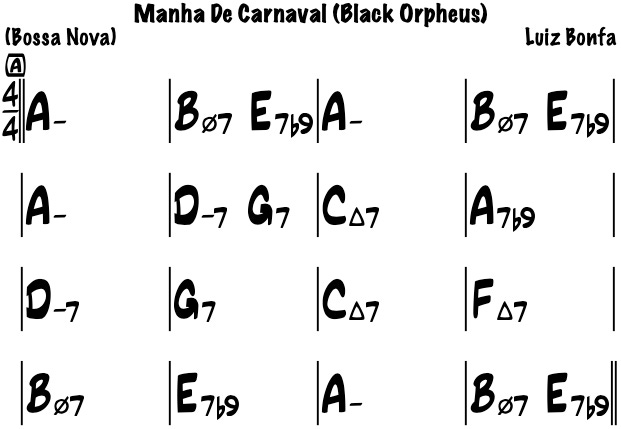
This tells us that the tonic temporarily changes from A minor to C major, so that the tonic centre in this section changes: A minor, C major (bars 5-12), A minor.
D-7 is the ii chord of C, and the A- is the vi chord of C; then, bars 5-7 are analysed as a vi-ii-V7-I, which is one of the most common patterns in modern jazz-based music
Bars 8-11 are analysed as VI7-ii-V7-I, where the A minor is changed to A dominant; it’s very common practice in jazz-based music to substitute a minor or major chord for a dominant chord to give the tune additional movement or energy.
Minor Keys
When you look at the chord chart, the tonal centre in bars 1-4 and 13-16 is the key of A minor.
The A minor scale is as follows:
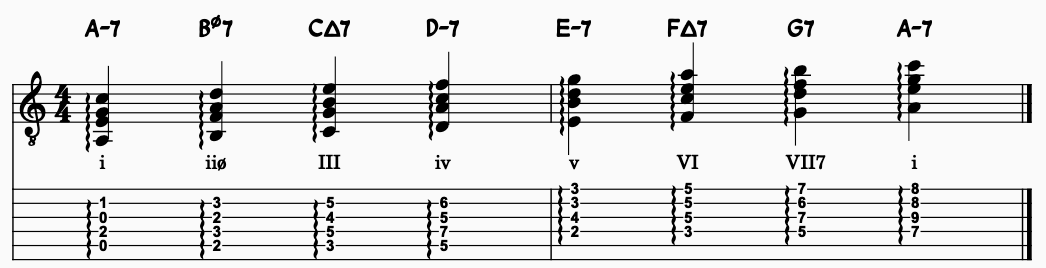
Minor scales are thought of as ‘relative’ scales to major scales starting on the 6th degree of the major scale
The 6th degree of the C major scale is A minor, so the A minor scale is the ‘relative minor’ of the C major scale, it’s essentially the C major scale starting on the 6th degree
Then the chords of the A minor scale will be the same, but we assign different Roman numerals with A-7 being the i chord.
V7-i Cadence in Minor Keys
If you look at the harmonised A minor scale, the v chord is E-7.
However, in the chord chart for Black Orpheus, you will notice that instead of E minor there’s an E7 chord: Bø7 – E7♭9 – A-.
This is because in jazz the V chord resolving to the minor tonic is usually played as a dominant:
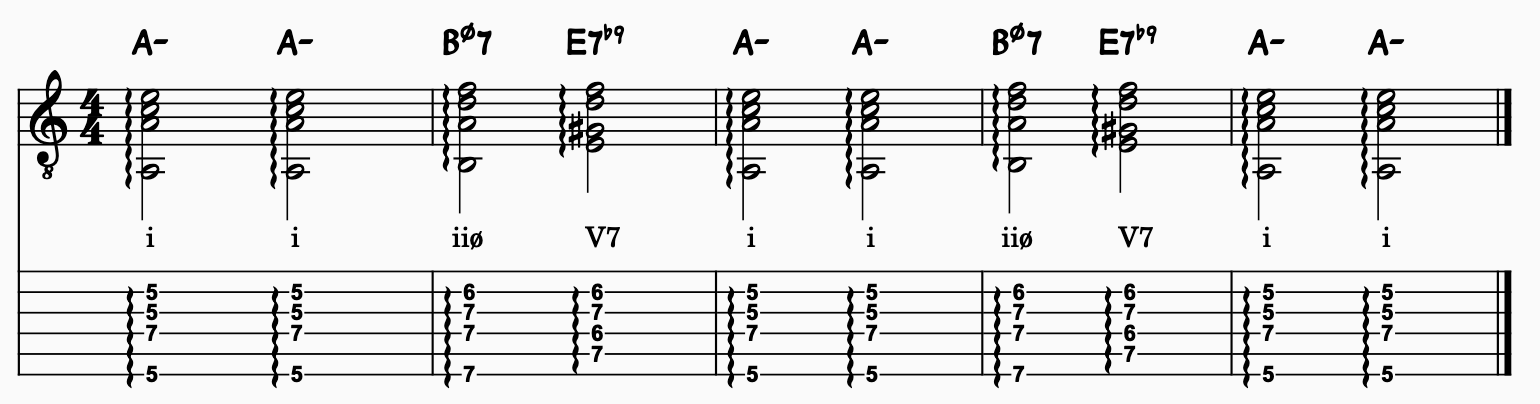
On charts you will often see this written as E7alt (”altered”); in practice, in minor key cadences, this means either ♭9 or ♭13.
Which one you play depends on position and voice leading (more on this in the next lesson).
So when you see E7♭9, E7♭13, or E7alt on a chart, you can choose whichever voicing works in a given position and leads well into the next chord.
Final Notes
The V–I cadence functions to create movement and establish temporary tonality in the tune, so expect to be spending much of your time looking for this pattern and learning the various ways it can be voiced.
Related keys
It’s also very common for a tune to switch between related major and minor keys as in Black Orpheus
A change in tonality (tonal centre) will be marked by the V–I pattern; so in Black Orpheus tonality changes from A minor to C major when you see the D-7 – G7 – C△7.
Substitutions
In jazz, the other chords in the scale, both minor and major, are commonly substituted for the dominant to establish a momentary V7–I cadence, because the dominant is very effective at creating energy and movement.
So if the progression is D-7 – G7 – C△7, it’s common to play the D minor as a D dominant: D7 – G7 – C△7; or if the chord chart specifies a D minor, jazz musicians might play D-7 – D7 – G7 – C△7, switching to D dominant before moving to G7.
Much of jazz study is concerned with exploring options for adding dominant chords even when they’re not given in the original score.
Please leave questions and comments below!
I publish solo guitar arrangements and studies with full harmonic analysis — standard notation, TAB, chord symbols, and Roman numeral analysis. Browse the catalogue on Payhip. If you’d like to support the work, you can become a paid subscriber or buy me a coffee.
This is SO HELPFUL! I’m going to have to read this about a thousand times to be able to incorporate it, but this answers so many questions I’ve had.
Quick question, though: what are the chord types in a “harmonized” minor scale? Is there a resource that lists those? I know I could probably figure it out, but it would be nice to know if I’m right about which chords are represented by each step in the harmonized minor scale, the way you did it with the harmonized major scale.