


In the previous lesson we looked at the V7–I cadence as the fundamental movement in Western music.
V7–I is the way harmony creates tension and resolves it, giving the tune a sense of forward motion away from and returning toward a tonic centre.
Another way we create movement and sense of flow in a chord progression is through the melody and what is called voice leading.
Normally we view the melody as being the melody line that is given in the lead sheet, which is played or sung at the top of the chords.
However, the ear also perceives the other notes in the chords in terms of melodic movement.
Voice leading refers to the idea that you want a smooth flow of the notes in each of these voices.
This is what makes a progression feel like music rather than a sequence of disconnected chord grips.
Voices and comping for vocals
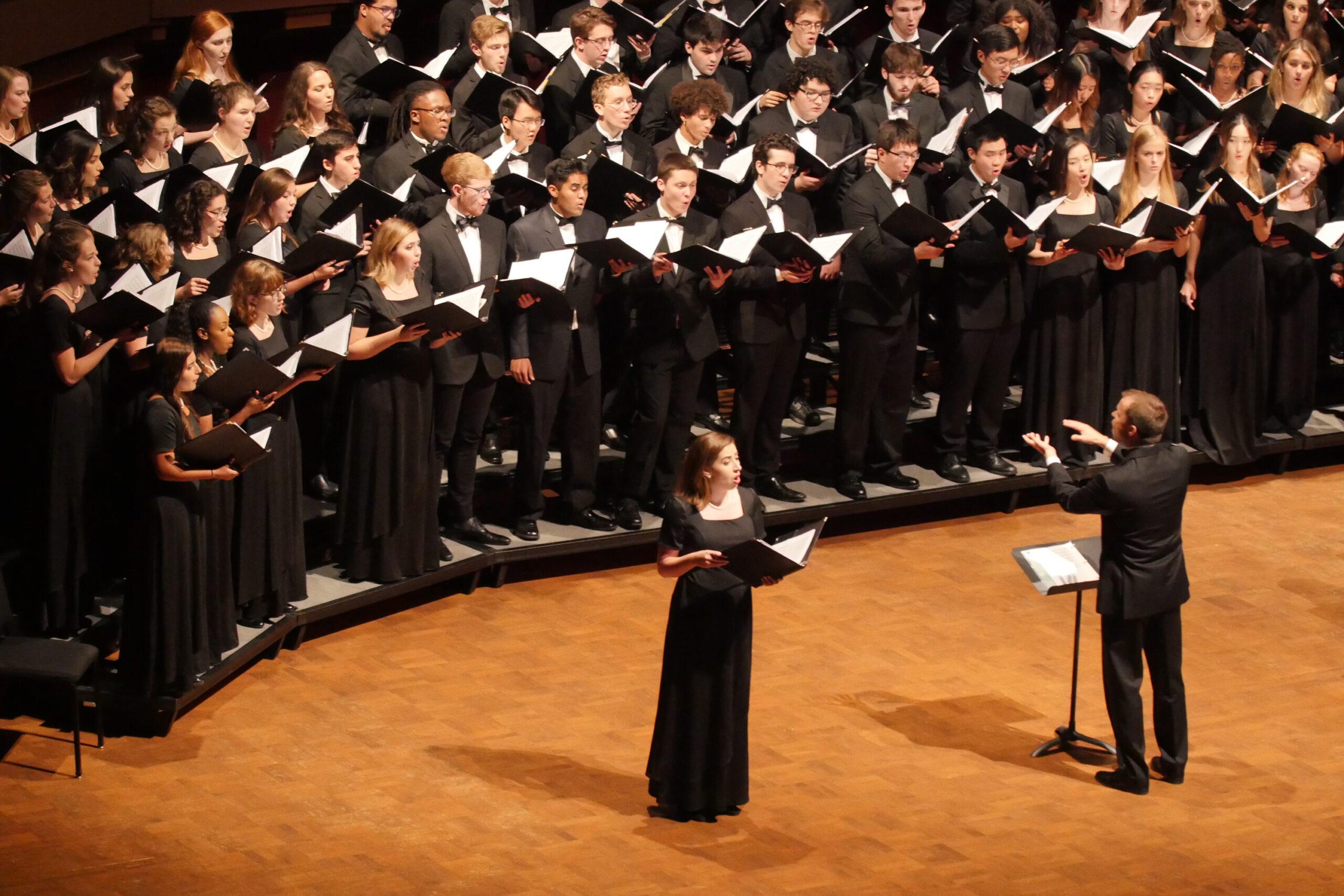
The idea of voices in music can be traced to sacred choral music in the Middle Ages.
A choir is divided into different vocal ranges.
Low voices are bass, baritone, and tenor, whereas high voices are alto, mezzo and soprano.
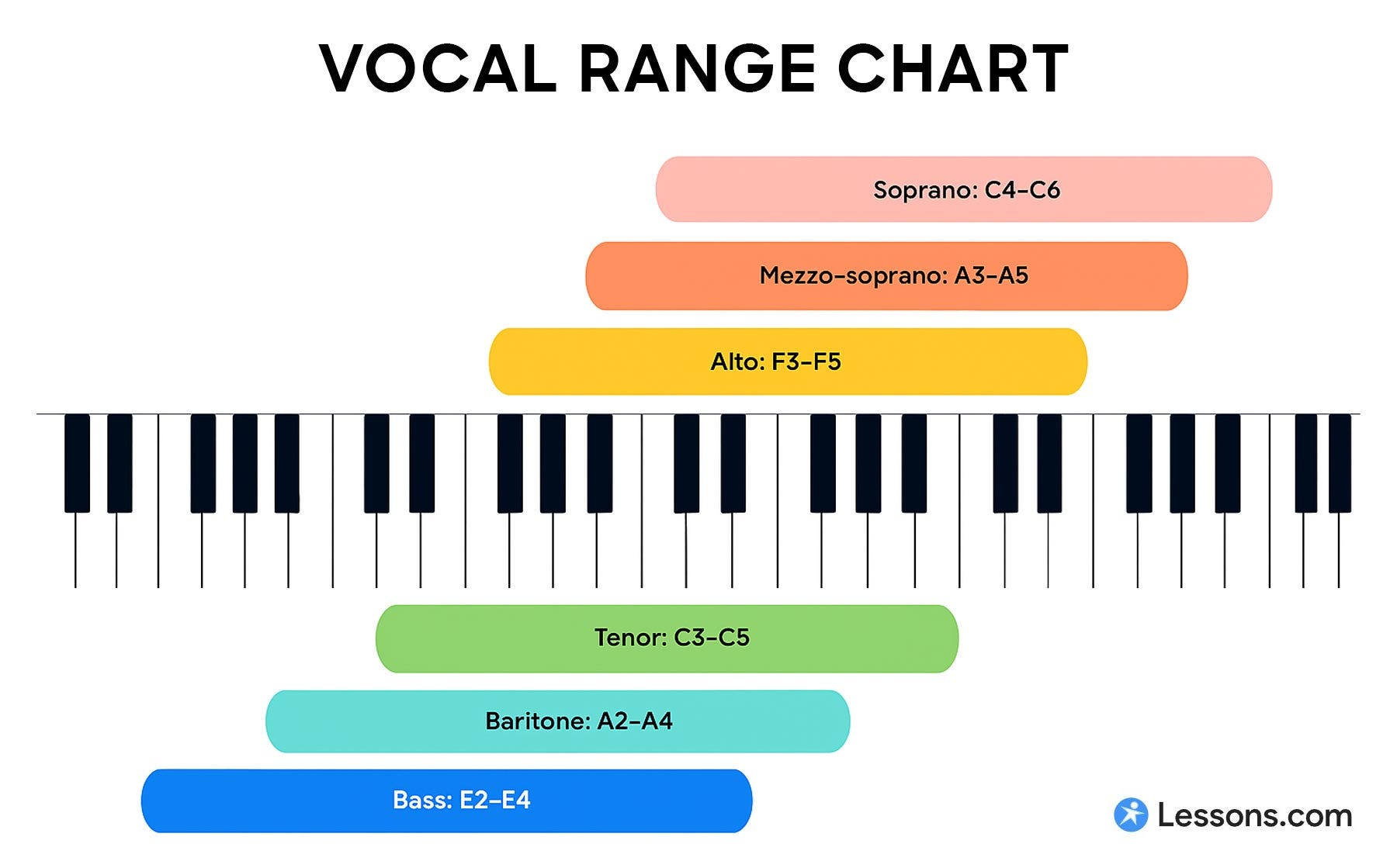
For guitarists understanding vocal ranges is useful if you’re arranging to comp behind a vocalist.
You should choose a key that supports the singer.
You figure out their vocal range by finding out the highest and lowest notes that they can comfortably sing, and choose a key in which the given melody is within that range.
Vocal ranges on the guitar:
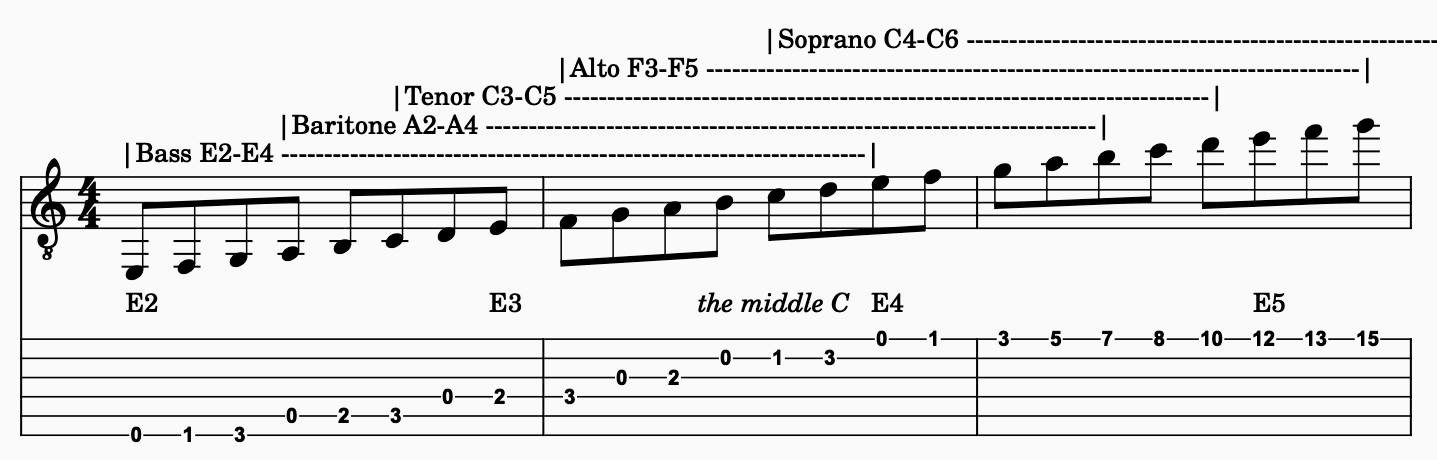
You can figure out your vocal range by singing the scale using the syllable ‘mum’, from the lowest possible to the highest.
Regularly singing the major scale and then singing or humming the melody of a tune you’re working on is great ear training even if you’re not a vocalist.
Polyphony
In a choir, the different voices sing harmonised melodies.
Each melody line would be independent, but together they would outline a harmony or chord.
When you play a chord on a polyphonic instrument like the guitar each of the notes can be viewed as a separate ‘voice’.
Then the movement from one chord to the next can be viewed as independent melodies moving simultaneously.
The sense of independent voices can be enhanced by arpeggiating the chords.
Also, reducing the movement in each of the voices makes the change from one chord to the next feel smoother, more connected or flowing.
Example 1 (electric):
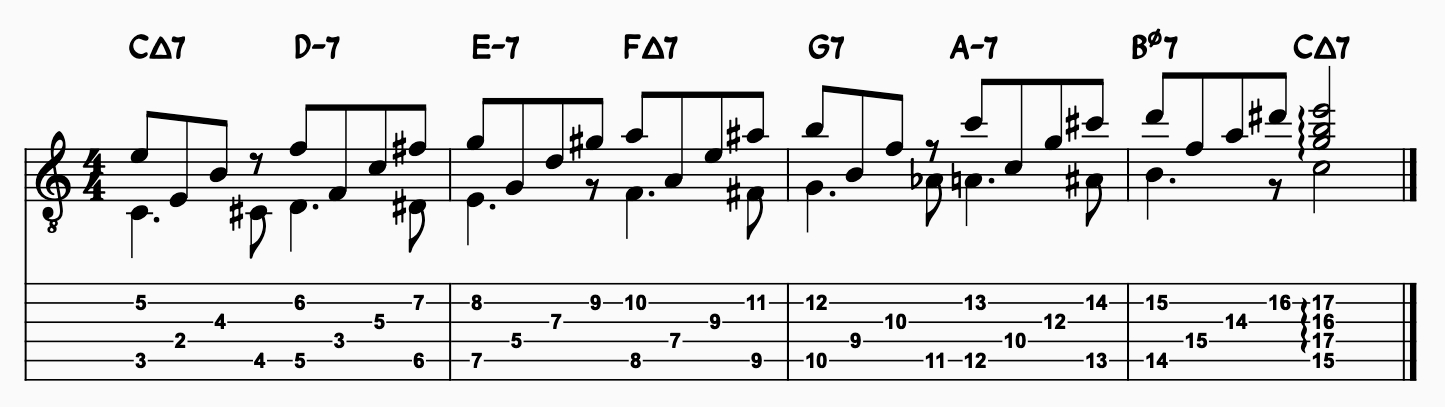
Example 1 (nylon):
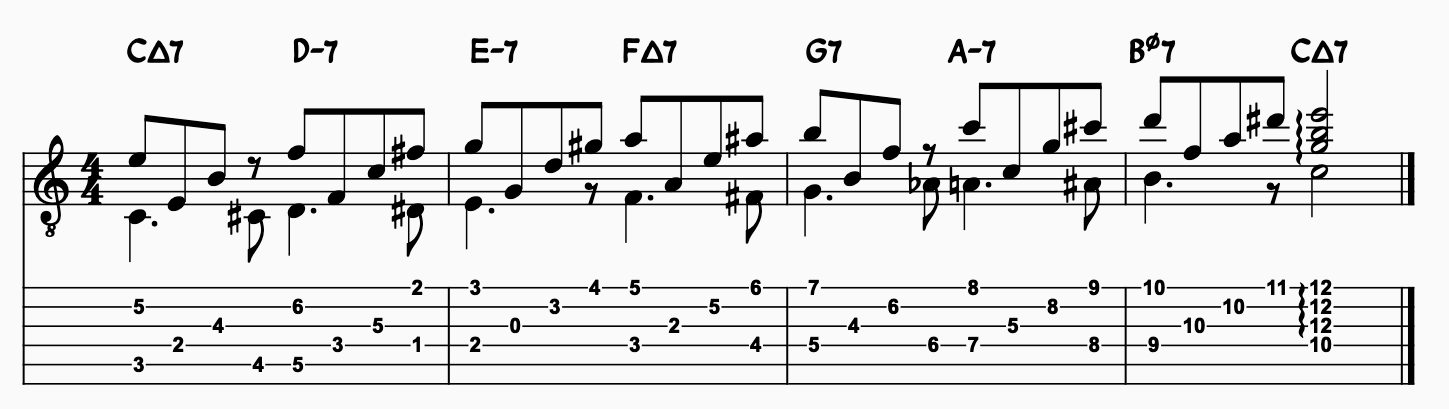
A chord can be divided into outer voices—the top and the bottom—and the inner voices
The outer voices are more prominent to the ear, especially the top voice which is perceived by the ear as the main melody
So a common technique on the guitar is to arpeggiate the chord starting on the outer voices and then outlining the inner voices as a fill.
Also, adding chromatic movement (moving in half steps) between tones in the outer voices enhances the feeling of flow, dynamism and movement.
Voice leading
Voice leading can be defined as follows:
Voice leading is the way individual melodic lines — the separate voices or parts — move and interact to form harmony, following the conventions of common-practice harmony and counterpoint.
The aim is for each voice to sound smooth and reasonably independent: shared notes are held as common tones where possible, and when a voice does move it travels to the nearest available chord tone, avoiding large leaps.
Because of this, the smoothest voice leading often comes from choosing particular voicings and inversions rather than playing every chord in root position.
For our purposes, we can understand voice leading in terms of connecting chords and keeping transitions relatively smooth.
When you move from one chord to another, you want something to carry the ear across the gap.
There are various ways of connecting chords including:
top-voice melody line
a moving bass line
a single-note run
chromatic movement
pedal note above or below moving chords
None of these is ‘correct’, what matters is that the chords feel connected, and that the line you choose has its own musical logic.
Example 2a: Different ways of arpeggiating and voice leading (V–I)
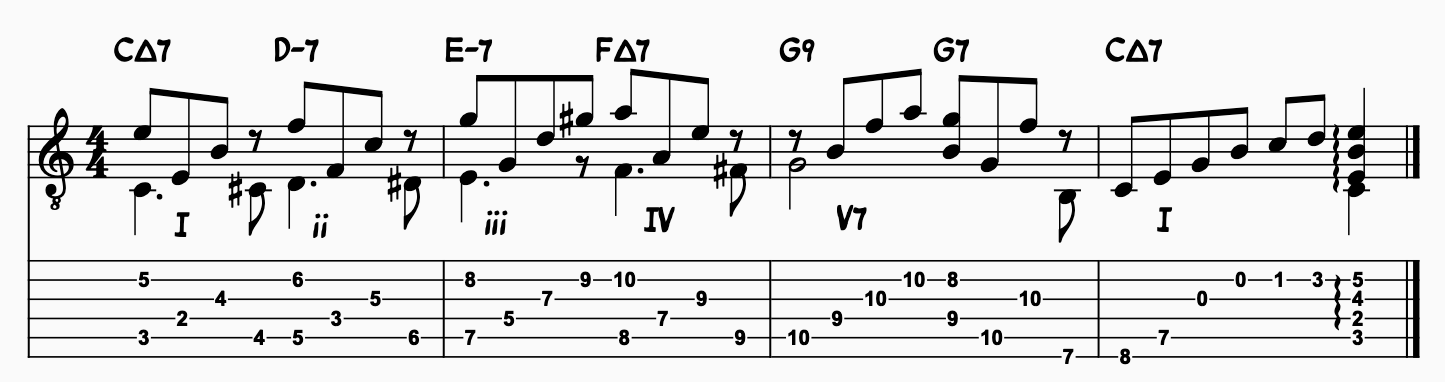
Example 2b
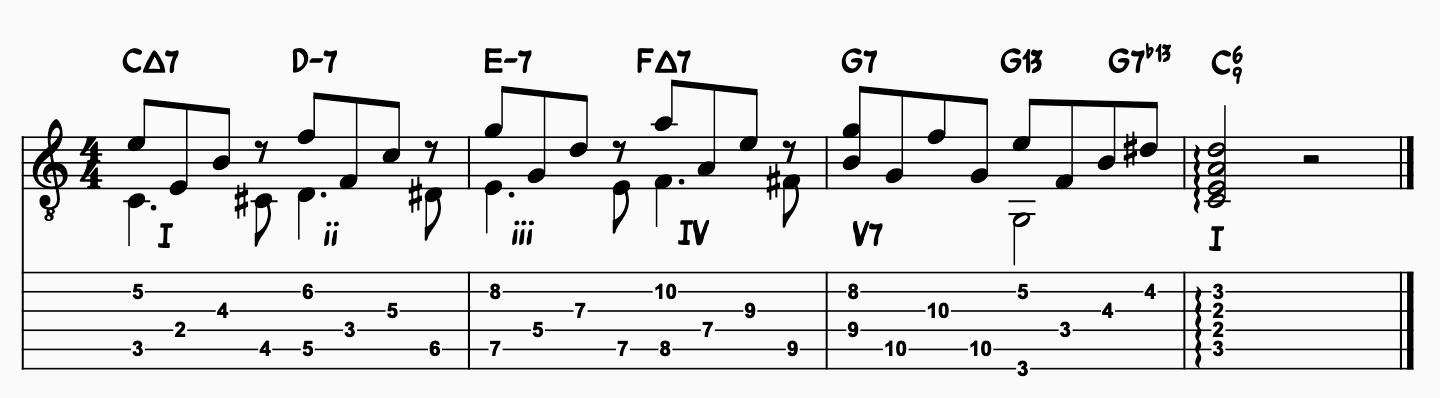
Ways to connect chords
There are several common approaches, and a good arrangement usually mixes them.
Common tones: if two chords share a note, keep it in the same voice — the shared note anchors the ear while the other voices move.
Step-wise motion: move a voice by a whole step or half step to the nearest note of the next chord. This sounds smooth and connected.
Melodic lines: use a single-note line — scalar, chromatic, or arpeggiated — to travel between chords, especially when the chords are far apart on the neck.
Bass movement: a walking bass line can carry the harmony forward while the upper voices do less work.
Inner voice movement: let the inner voices shift chromatically or by step while the outer voices hold.
Chromatic movement: step-wise motion by half step; works because the ear hears the half step as the smallest possible motion; lets you pass through notes that aren’t in the key, which adds colour without disrupting the harmony.
Example 3: A way to voice lead a ii–V7–I
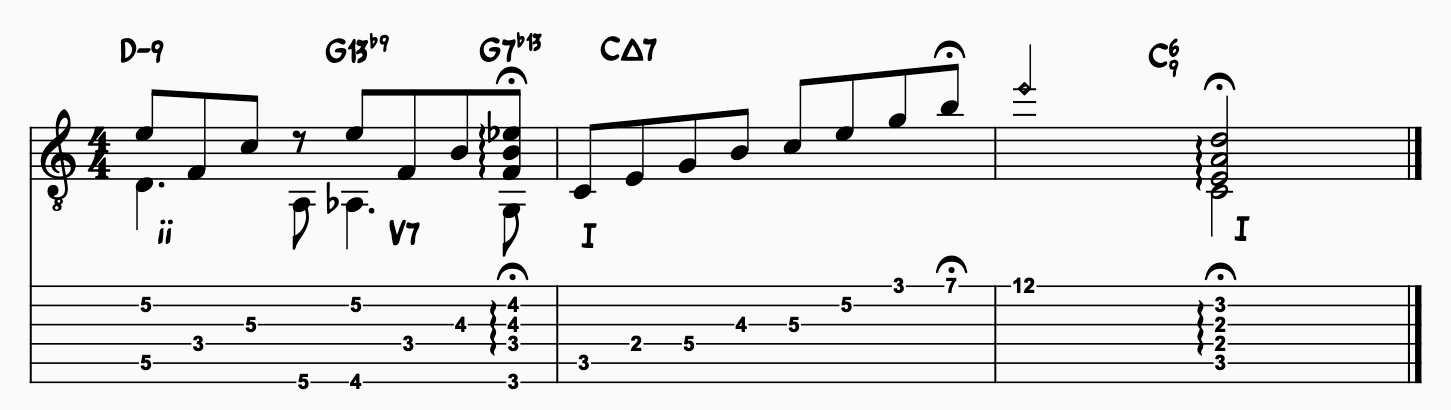
Final Notes
Voice leading is what turns a chord chart into an arrangement.
The chord symbols tell you what harmony is being used; voice leading is a series of techniques to move between them.
A common misconception is that voice leading just means moving each voice as little as possible.
Smooth step-wise motion is one approach that is very commonly used, but if you look at how players like John Stowell move between chords, you’ll often see larger jumps up and down the neck connected by single-note lines.
So voice leading between chords can utilise small chromatic movement, or it might utilise wider chord tone intervals.
I publish solo guitar arrangements and studies with full harmonic analysis — standard notation, TAB, chord symbols, and Roman numeral analysis. Browse the product catalogue on my online shop. If you’ve found this useful, you can also buy me a coffee or become a paid subscriber.
This is great! I can’t wait to put this to work! Thank you!!