

Brazilian Guitar — Baden Powell
21 performance ready guitar arrangements


I’ve just published Brazilian Guitar: Baden Powell — a collection of 21 edited transcriptions from the solo guitar recordings of Baden Powell, re-engraved from scratch for readability and formatted for iPad or print performance.
This has been the most challenging editorial project I’ve taken on, and it’s worth explaining why.
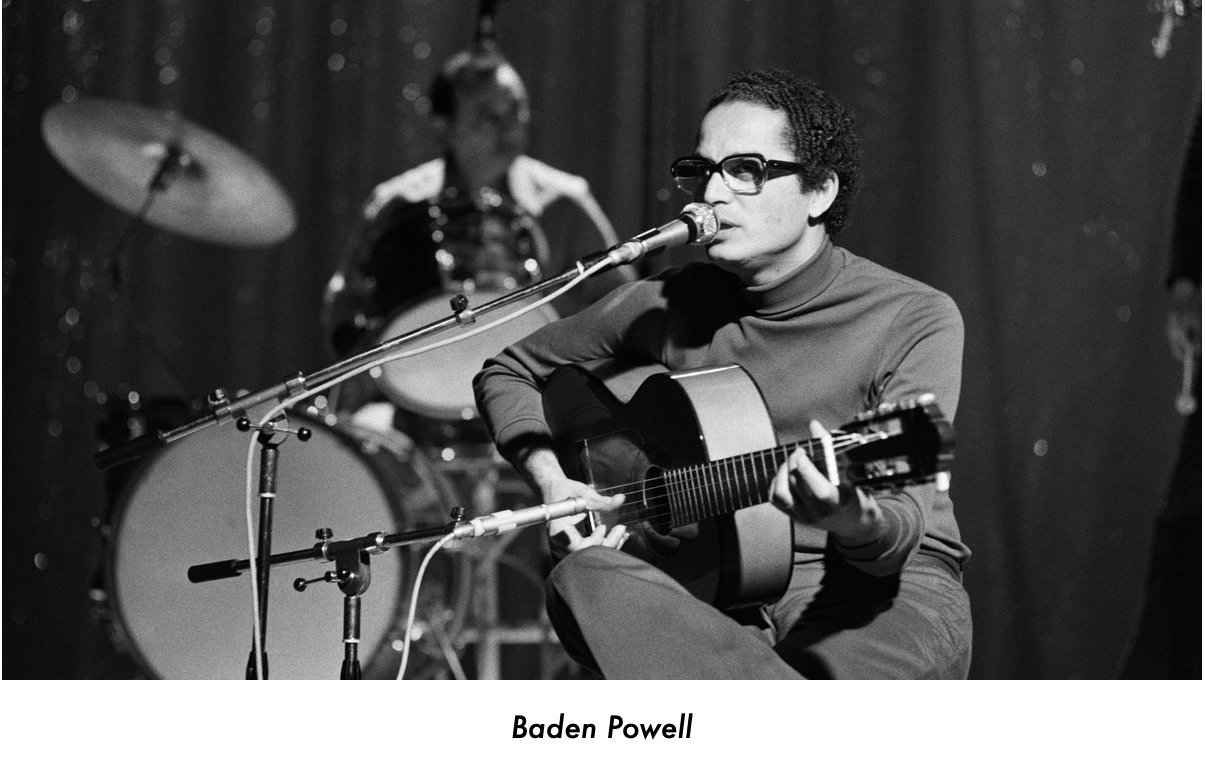
Baden Powell
Baden Powell de Aquino was born in 1937 in Varre-Sai, in the state of Rio de Janeiro, the eldest child of a shoemaker who was also a violinist and a devoted admirer of the founder of the Boy Scouts — hence the name.
The family moved to the Rio suburb of São Cristóvão when Baden was still an infant, and the house became a regular gathering point for musicians, including Pixinguinha and Donga, two foundational figures of Brazilian popular music.
At eight years old, Baden began guitar lessons with Jayme Florence, known as Meira, one of the leading choro guitarists of the 1940s and a member of Benedito Lacerda’s regional ensemble.
Meira gave him two things that would define the rest of his career: fluency in the Brazilian popular guitar tradition — choro, samba, the whole rhythmic and melodic vocabulary — and a grounding in the classical Spanish guitar repertoire, specifically the music and technique of Francisco Tárrega and Andrés Segovia.
By thirteen he was playing professionally, and by fifteen he was earning a living accompanying singers and bands across multiple styles.
In the mid-1950s he joined pianist Ed Lincoln’s trio at the Bar Plaza in Copacabana, where his playing caught the attention of Antônio Carlos Jobim.
He studied advanced harmony with Moacir Santos, one of the most sophisticated harmonic thinkers in Brazilian music — a composer and arranger who brought together jazz, European modernism, and Afro-Brazilian traditions into a deeply original harmonic language.
Santos is an under-appreciated figure in the story of Brazilian music, and his influence on Baden Powell’s harmonic vocabulary is audible throughout these recordings: the extended voicings, the chromatic movement, the way dissonance is used for colour rather than tension.
Baden Powell cited Garoto — Aníbal Augusto Sardinha — as a key influence, alongside Dilermando Reis and Django Reinhardt.
The Garoto connection matters: Garoto was arguably the first Brazilian guitarist to bring jazz harmony into the solo guitar tradition, and his innovations in chord voicing and voice leading created the harmonic foundation on which bossa nova was built.
In 1962, Baden Powell met the poet and diplomat Vinícius de Moraes, beginning a partnership that would produce some of the defining music of the decade.
While bossa nova was the prevailing sound, Baden and Vinícius were reaching further — combining samba with Afro-Brazilian ritual music from the candomblé and capoeira traditions, resulting in the landmark 1966 album Os Afro-Sambas de Baden e Vinícius.
At nineteen, he made the decision to stop playing electric guitar entirely, concentrating on classical nylon-string guitar for the rest of his career.
He recorded prolifically — for Elenco and Forma in Brazil, Barclay in France, MPS/Saba in Germany — and toured Europe extensively through the 1960s before relocating permanently to France in 1968.
The European period
The move to Europe is significant for understanding the material in this book.
Living in France, touring German concert halls, recording for the MPS label with producer Joachim Berendt, Baden Powell was operating in a very different environment from the Rio club scene where he’d made his name.
European audiences knew him as a classical guitar virtuoso, and the concert hall context drew out a different side of his playing.
Through the early 1970s — the period from which most of the recordings in this collection are drawn — his solo work became increasingly introspective, moving away from the rhythmic drive of his combo recordings toward something more contemplative and sustained.
The album Solitude on Guitar, recorded in Frankfurt in 1971, opens with a reading of a Vinícius de Moraes poem-setting that reviewers described as distinctly more classical than anything he had previously recorded — clean, precise, unhurried.
Apaixonado, recorded in Rio in 1973 for the German MPS label, contains both Alcântara and Estórias de Alcântara, pieces that sound more Spanish than Brazilian — the Tárrega and Segovia influence laid bare, with jazz harmony thinning out and the European Romantic guitar tradition coming to the foreground.
Solitário was composed during the lonely hours before a recording session in Germany, while Baden Powell was separated from his wife Márcia — the emotional circumstances reflected directly in the music’s sustained, introspective character.
This is the period where his solo guitar voice is most fully itself, and it’s the period this book primarily documents.
The impressionistic style
The word I keep coming back to for Baden Powell’s solo guitar approach is impressionistic.
In his combo recordings — the bossa nova and samba material with bass and drums — he is a rhythmic engine, the right hand driving patterns in the 2/4 samba metre, the bass locked into a groove, the whole thing propelled forward by the ensemble.
In the solo recordings, all of that rhythmic scaffolding drops away.
What remains is sustained bass notes ringing under arpeggiated melody, rubato phrasing where the barline is a suggestion rather than a boundary, and a harmonic palette that prioritises colour over function.
He plays with a heavy right-hand attack positioned close to the bridge, which produces a bright, overtone-rich bass — the fundamental rings clearly, but so does the harmonic series above it, giving the low notes a resonance and complexity that you don’t get from the warmer, rounder tone of playing over the soundhole.
This is a deliberate sonic choice, not an accident of mic placement, and it connects back to his study with Moacir Santos: the overtone spectrum becomes part of the composition, not just a byproduct of the instrument.
He separates bass and melody notes rhythmically — the bass lands slightly ahead of the treble on each beat, giving every phrase a breathing, arpeggiated quality rather than the simultaneous block-chord attack that characterises conventional classical guitar performance.
The left hand contributes constant ornamentation: hammer-ons, pull-offs (ascending and descending slurs, in classical terminology), slides, and chromatic passing tones woven into the melodic line so pervasively that they become part of the texture rather than occasional decorations.
On repeated passages he will embellish differently each time — these ornaments are improvisational in character, part of his expression rather than part of the composition itself.
The closest analogy I can think of outside the Brazilian tradition is the sustained, breathing approach of jazz guitarists like John Stowell — let the notes ring, let the chord speak, prioritise harmonic colour over rhythmic momentum.
Stowell arrives at that aesthetic from jazz abstraction; Baden Powell arrives at it from classical guitar technique meeting jazz harmony somewhere in the middle.
Different roads, same destination: make fewer notes mean more by letting them resonate.
The Spanish-sounding pieces
One of the most striking things about working through this material was discovering that several of Baden Powell’s compositions don’t sound Brazilian at all.
Alcântara and Violão could easily pass for 19th-century Spanish guitar music — arpeggiated, lyrical, Romantic in temperament, built on triads and simple chord progressions rather than the extended jazz harmony that characterises his bossa nova work.
Solitário, composed in Germany during the Solitude on Guitar sessions, occupies similar territory.
This isn’t an anomaly — it’s a window into the layers of his musicianship.
The classical Spanish guitar tradition was foundational to his technique and musical imagination, absorbed from his very first lessons with Meira in the 1940s.
In most of his repertoire, that European classical foundation is fused with Brazilian rhythm and jazz harmony in a way that sounds unmistakably Brazilian.
But in these pieces, the Brazilian rhythmic layer drops away and the Spanish classical root is exposed — what you hear is essentially the voice of his teachers, filtered through his own sensibility and touched with just enough jazz-influenced harmony to distinguish it from pure Tárrega.
The name Alcântara itself carries this layered history: it refers to a colonial Portuguese town in the northern Brazilian state of Maranhão, but the word comes from the Arabic al-qantara — “the bridge” — a place name that originated in Extremadura, Spain, referring to a Roman bridge that the Moors named when they occupied the Iberian Peninsula.
Portuguese colonists carried the name to Brazil.
So the name is literally Iberian — Moorish Arabic filtered through Spanish and Portuguese colonialism — and the music sounds exactly like that etymology implies.
The repertoire
The 21 pieces in this collection span a wider range than you might expect from a single guitarist’s catalogue.
The foundation is a set of traditional Brazilian compositions from the early generation of solo guitarists: Abismo de Rosas by Canhoto, the foundational valsa-choro of the Brazilian guitar repertoire, and Gente Humilde and Jorge do Fusa by Garoto, the proto-bossa nova innovator whose harmonic language Baden Powell absorbed and extended.
Several pieces are Baden Powell’s own instrumental compositions — Brasiliana, Retrato Brasileiro, Sentimentos, Tema Triste — works that sit in the space between choro and bossa nova without belonging exclusively to either tradition.
Apelo and So Por Amor come from his collaborations with Vinícius de Moraes.
Viagem, by João de Aquino (Baden Powell’s cousin) with lyrics by Paulo César Pinheiro, was first recorded by Baden Powell in 1969 in a solo instrumental version — the earliest recording of what would become a Brazilian popular standard.
Three well-known Jobim compositions — Por Causa de Você, O Que Tinha de Ser, and Se Todos Fossem Iguais a Você — receive Baden Powell’s characteristic solo guitar treatment, which transforms them from vocal bossa nova into something closer to through-composed instrumental pieces.
Alcântara, Violão, and Solitário are the Spanish-sounding compositions discussed above.
Ária Para Se Morrer De Amor is an unusual piece that functions almost as atmospheric drone music — it doesn’t follow standard harmonic progressions and produces some striking, challenging chord voicings that sit outside any easy genre classification.
Round About Midnight by Thelonious Monk and Manhã de Carnaval by Luiz Bonfá — the latter having become a jazz standard in its own right — offer a window into the space where jazz meets Brazilian nylon-string guitar, and are worth exploring for jazz players looking to bring repertoire onto the classical instrument.
El Dia Que Me Quieras by Carlos Gardel brings a tango into the collection, a reminder that Baden Powell’s musical curiosity extended well beyond Brazilian borders.
And Valsa Sem Nome — Baden Powell’s own Brazilian waltz — is transcribed here in his more extended performance version, with a developed introduction and more legato, impressionistic phrasing than the simpler arrangement commonly found elsewhere, showing how his performances evolved toward greater harmonic colour and expressive freedom.
About these editions
If you’ve ever tried to read an existing transcription of Baden Powell’s solo guitar recordings, you’ll understand why this project took as long as it did.
His playing is so heavily ornamented — constant slurs, slides, chromatic passing tones, arpeggiated attacks — that a literal transcription of everything audible on the recording produces a score that is visually overwhelming and practically unreadable.
The transcriptions that circulate online tend to be sourced from a small number of websites, possibly generated with the assistance of automated transcription software, and they reproduce this density faithfully without any editorial intervention to make the result playable from the page.
These editions have been re-engraved from scratch with readability as the priority.
My editorial contribution has been to clean up rhythm, phrasing, and bar structure; organise each piece into clearly signposted sections with symmetrical four-bar-per-line layouts; and format everything for continuous reading on iPad or in print, with no repeat signs.
Baden Powell’s harmonic language and voice leading have been preserved with minimal modification — what has been simplified is the ornamentation.
Because the slurs and slides are improvisational rather than structurally fixed — he embellishes differently on every pass through a repeated section — notating all of them would misrepresent them as composed elements and clutter the score unnecessarily.
I have included the slurs that define the melodic line, and I encourage players to listen to the recordings and add their own embellishments in the same spirit.
These are not academic study scores — they are performance editions designed to be slapped onto an iPad and played.
I publish separate study scores with full chord symbols and Roman numeral harmonic analysis for individual pieces, and I’ll be writing more about Baden Powell’s harmonic language and playing approach in upcoming articles.
Subscribe here for updates on new lessons, study scores, and articles.
Contents
Abismo de Rosas (Canhoto) · Alcantara · Apelo · Ária Para Se Morrer De Amor · Brasiliana · El Dia Que Me Quieras (Gardel) · Gente Humilde (Garoto) · Jorge Do Fusa (Garoto) · Manhã de Carnaval (Bonfá) · O Que Tinha De Ser (Jobim) · Por Causa De Você (Jobim) · Retrato Brasileiro · Round About Midnight (Monk) · Se Todos Fossem Iguais A Você (Jobim) · Sentimentos · So Por Amor · Solitario · Tema Triste · Valsa Sem Nome · Viagem (João de Aquino) · Violão
Grab it here: Brazilian Guitar - Baden Powell