


There is a common misunderstanding of tango that operates on two levels.
The first is the idea that tango is a uniquely Argentine folk music — a self-contained ethnic tradition without antecedents or external influences.
This is straightforwardly false, in the sense that tango as an identifiable musical genre emerged around 1890 out of the collision of several existing genres: the Cuban habanera, European dance forms imported by waves of immigration (esp. Mazurka), and the Afro-Argentine candombe and milonga of the Río de la Plata.
The earliest tangos were called música criolla — Creole music — precisely because the form was understood by its own first audiences as a fusion rather than as something endemic and untouched.
The second misunderstanding is the idea that ‘traditional’ tango is dance music, played by large orchestras in the 1930s and 1940s, with a heavy rhythmic emphasis and a defined social function on the dance floor.
However, when you look at major compositions of the 1920s and 1930s — Juan Carlos Cobián’s Nostalgias, Los Mareados and Flores Negras, the work of Enrique Delfino, the De Caro school more broadly — what you find is not European salon music with a Latin rhythm pasted on top.
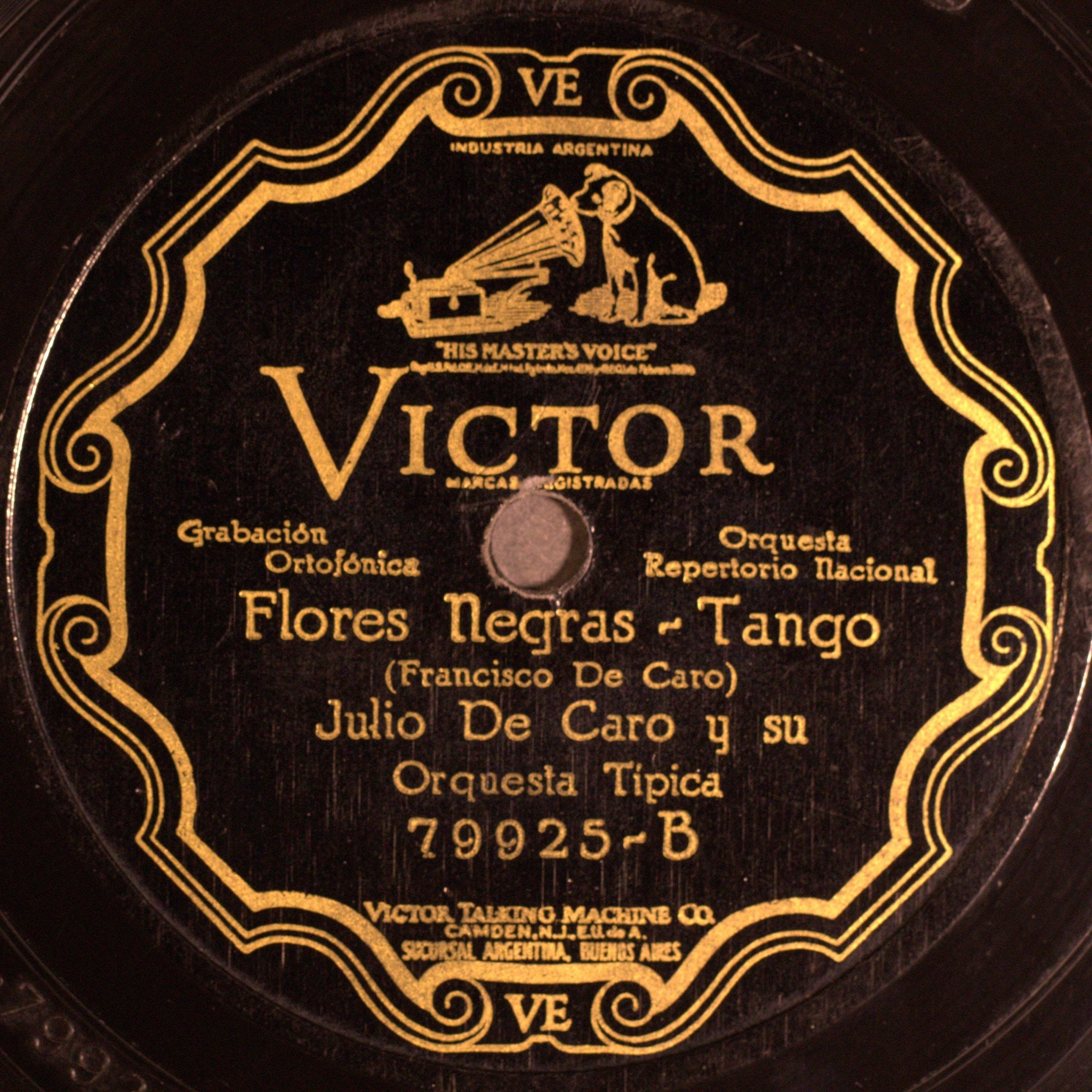
You find harmonic writing that uses extended chords, secondary dominants, chromatic voice leading and pre-dominant chains in ways that are unmistakably drawn from the jazz harmonic vocabulary.
The natural question is how that harmonic vocabulary reached Buenos Aires so early in the genre’s development.
The explanation is that the Argentine composers who built this side of the tradition — Cobián above all, but also figures like De Caro, Delfino, and Osvaldo Fresedo — were classically trained musicians who travelled to the United States, particularly to New York, and absorbed jazz harmony directly from the source.
They returned to Buenos Aires with a dual fluency in classical and jazz harmonic practice, and they applied that fluency to the tango compositions that became the foundation of what was referred to as tango romanza.
In the 1930s a reaction set in against this concert-oriented strain of tango, led by figures like Juan D’Arienzo, who pushed the form back toward its function as dance music with a heavily rhythmic, staccato style — with his pianist Rodolfo Biagi’s orchestra pushing the staccato percussive style of playing to the extreme (and D’Arienzo himself following in suit).
This was the orillero line: rhythm-first, dance-floor-oriented, comparatively spare in harmony.
But the romance tradition did not disappear in the 1940s; it continued underneath the dance-orchestra surface in the work of Aníbal Troilo, Ángel D’Agostino, and Osvaldo Pugliese who retained the harmonic sophistication of the 1920s while working within the larger ensemble formats of the 1940s.
Troilo’s line continued forward into Astor Piazzolla, who studied with Troilo, absorbed his harmonic approach, and pushed it further by adding explicit jazz and classical-music elements to produce nuevo tango.
The continuous thread runs from the tango romanza of the 1920s, through Troilo’s harmonic refinement of the 1940s, into Piazzolla’s full fusion in the 1950s and beyond — and the entire arc could reasonably be called tango jazz, because the harmonic vocabulary at every stage is recognisably the jazz harmonic toolkit applied to tango forms.
What follows is the biographical detail behind that arc — the specific Argentine musicians who lived and worked in New York during the 1920s and 1930s, the connections between them, and the institutional channels through which jazz harmony reached tango.
The tangueros in New York
Juan Carlos Cobián (1896–1953)
Juan Carlos Cobián was an Argentine pianist and composer, and one of the central figures of the guardia nueva — the “new guard” generation of tango musicians that emerged in the early 1920s.
Within that generation, Cobián led what was called the evolucionista tendency, pushing tango away from its dance-music origins and toward concert music.
After establishing himself in Buenos Aires, Cobián travelled to New York in the late 1920s and lived there for several years, working professionally in both tango and jazz.
He returned to Buenos Aires in 1928, then went back to the United States around 1937 and remained there for another five years before returning home in 1943.
The total time he spent in the US was therefore close to a decade, all of it spent moving between the two genres on a working basis.
Cobián’s most famous compositions — Nostalgias, Los Mareados, Nunca Tuvo Novio, La Casita de Mis Viejos, Flores Negras — are exactly the harmonically rich, romantic tangos that defined tango romanza and that benefit most from analysis using jazz-harmonic concepts.
Carlos Gardel (c. 1890–1935)
Carlos Gardel was the defining tango singer of his era, and from late 1933 until his death in mid-1935 he lived in New York, recording his last twenty-two titles there and starring in four films for Paramount Pictures shot at the Astoria Studios in Queens.
The films — Cuesta abajo, El tango en Broadway, El día que me quieras, and Tango Bar — were aimed at the Latin American market but were produced inside the American film industry, with American studio resources and an Argentine creative team based in New York.
Among the songs Gardel recorded for these films was Rubias de New York, a foxtrot rather than a tango, written by Gardel himself with lyrics by Alfredo Le Pera.
Terig Tucci (1897–1973)
Terig Tucci is less well known than Cobián or Gardel, but he was probably the most important figure for the actual mechanics of cross-pollination between tango and the American music industry.
Tucci was an Argentine composer, orchestrator, conductor, and multi-instrumentalist who left Buenos Aires for New York in 1923 and remained there for the rest of his career.
From 1930 to 1941 he played in the NBC Orchestra, and in 1932 RCA Victor appointed him executive producer of its Latin American music unit — a position he held until his retirement in 1964.
In 1934 he became orchestrator and musical director for Carlos Gardel’s Paramount Pictures films, transcribing Gardel’s compositions into staff notation and writing the orchestral arrangements that accompanied him on screen.
Tucci therefore sat at the precise point where Argentine tango compositions were being rendered into orchestral scores using American big-band orchestrational resources, which made him one of the first people to physically combine the two vocabularies on a working scoring desk.
He published a memoir of his work with Gardel, Gardel en Nueva York, in 1969.
Astor Piazzolla (1921–1992)
Astor Piazzolla lived in New York from 1925 to 1936, between the ages of four and fifteen, and the New York he grew up in was the same New York that Cobián, Gardel, and Tucci were working in.
He acquired his first bandoneon there, took bandoneon lessons from Terig Tucci himself, and as a fourteen-year-old played a small role as a newspaper vendor in Gardel’s El día que me quieras in 1935.
The harmonic and orchestral world that Piazzolla absorbed before the age of fifteen was therefore the world that Tucci had built around Gardel’s recordings and that Cobián had been operating in during his own New York residencies.
When Piazzolla later studied with Aníbal Troilo and then with Nadia Boulanger in Paris, he was building on a foundation that already included direct exposure to the jazz-tango exchange of 1930s New York.
The two-way exchange in Buenos Aires
The traffic was not only one-directional.
By the 1920s, Buenos Aires had its own jazz scene, and tango orchestras competed directly with jazz bands for the dance-floor audience.
Many of the leading tango orchestras of the period — including those of Francisco Canaro, Juan de Dios Filiberto, Francisco Lomuto, Osvaldo Fresedo, Juan Carlos Cobián, Julio De Caro, Edgardo Donato, and the Victor Typical Orchestra — incorporated tango-foxtrot and jazz sets into their working repertoire.
So the same musicians who were writing harmonically ambitious tangos were also playing jazz on a regular basis, often within the same evening’s performance, which meant that the harmonic vocabulary was alive in their hands as practical working material rather than as something absorbed at a distance from records.
The lineage
The line that runs from this early period through to the present is reasonably clean.
Cobián and his contemporaries write the foundational tango romanza repertoire of the 1920s and 1930s, drawing directly on the jazz harmonic vocabulary they absorbed in New York.
Aníbal Troilo carries that harmonic sophistication forward through the Golden Age dance-orchestra era, retaining the chord vocabulary while accommodating the larger ensemble formats of the 1940s.
Astor Piazzolla, who studied with Troilo and grew up in the New York environment that Tucci helped build, takes the synthesis further into explicit fusion in the 1950s and beyond.
The arrangements I’ve published in Romantic Tango Guitar Volume 1, based on the work of Aníbal Arias, sit squarely within this lineage.
Arias was working with the same harmonic vocabulary, applied to solo guitar, and his arrangements of Cobián’s Nostalgias and Los Mareados — and of De Caro’s Flores Negras — are direct descendants of the line that started with the Argentine musicians who travelled to New York a century ago.
I publish solo guitar arrangements and studies with full harmonic analysis — standard notation, TAB, chord symbols, and Roman numeral analysis. Browse the product catalogue on my online shop. If you’ve found this useful, you can also buy me a coffee or become a paid subscriber.
This is so great! Fascinating! I am going to read this again slower later. So much good stuff in here!
What do you think of the contemporary links Tango/Jazz; for instance, the album Tangomorphosis of Pablo Estigarribia or something like "Blues de Boedo" of Alfredo Tape Rubin.